
nRF5x Module or Bare IC? Making the Right Call Before You Lock In Your BoM
nRF5x module or chip-down? BoM savings against NRE and certification costs, and why the breakeven for BLE products sits at 15,000 to 25,000 units.
By Nathan Ruttley, CEO and Co-Founder··3 min read
A single decision made at schematic stage can add £4-5 to every unit you ship, or cost you £50,000+ in design and certification before you sell a single device.
A module from u-blox or Raytac combines an nRF5x SoC, antenna matching, and sometimes an oscillator in an easy to design-in package. The bare Nordic IC doesn't have any of these home comforts but offers the maximum number of pins, and a lower BoM cost. The decision is all about risk, time to market, and cost.
The case for modules
Modules win in two categories. The first is implementation cost. Provided that the manufacturer has good reference layouts and the size of the module doesn't compromise other areas of the design the implementation effort will typically be measured in days rather than weeks.
The second category is compliance. If you stay within the parameters of the module vendor's Grant of Authorisation (antenna type, matching network, power limits) then you will hopefully sail through emissions testing without having to embark on a full suite of RF emissions testing for intentional radiators.
That's a saving of 4-8 weeks on your compliance testing, and a big reduction in risk as you shouldn't have to re-test - not to mention £15,000-20,000+ in lab costs - and that's before we look at compliance for regions outside of the EU/North America!
Where chip-down wins
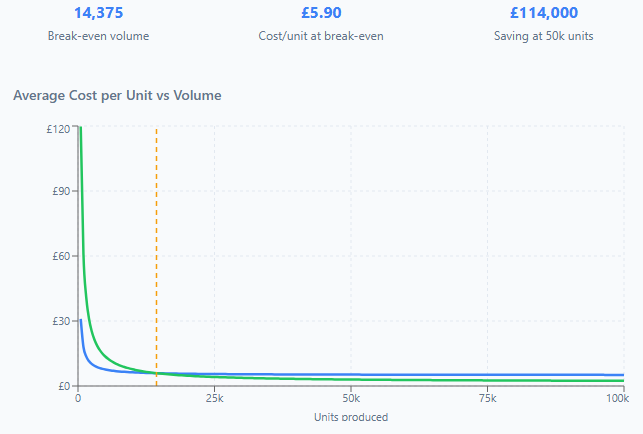
The clear advantage here is cost. Whilst a module will run to at least £4-6 at high quantities, the bare IC can be less than half of this depending on the exact model. At 25,000 units that is at least £50,000-75,000 of savings just on the BoM.
The downside is that a large portion of those savings will be wiped out by the increase in NRE costs: design-in and prototyping costs will be significantly higher, and the certification costs for FCC alone will add a significant cost up-front.
The breakeven point, where the savings outweigh the NRE costs, will typically be somewhere between 15,000-25,000 units.
If you want to have a play with the numbers, I've built a module vs chip-down calculator.
Our recommendation
We almost always recommend starting with a module. The huge reduction in design-in cost and certification risk are enough to persuade most clients, but there is one more big win.
Chip-down and all of the associated challenges can be a big distraction for a small engineering team. By using a module you can focus your engineering effort on the parts of the product that will make it stand out in the market - and for most consumer products that isn't a test report!
Once you're shipping units, the transition to chip-down may be a worthwhile exercise, but timing is everything and going for it too early can be costly.
We have had great success with modules across BLE, Wi-Fi, and GNSS. Modules aren't a sign of unprofessional engineering, they are a tool to help you balance risk, cost, and speed across an engineering project and a product's lifecycle.
If you're scoping a wireless hardware product and working through this decision, we're happy to walk through it with you. Our Bluetooth product design team works on both nRF52 and ESP32 platforms.
Related services
Bluetooth Product Design →
Bluetooth Low Energy products designed end to end, electronics, antenna and firmware, on Nordic nRF52 and Espressif ESP32 platforms.
PCB Design Services →
Schematic capture, multi-layer PCB layout and design for manufacture, delivered by engineers who also build and test the boards they draw.
Embedded Software and Firmware Development →
Embedded firmware written for performance, power efficiency and long-term maintainability, on hardware we understand because we designed it.
Working through this on your own product?
Tell us what you are building and what you need to find out next.